
There was a time when humans lived as part of nature.
Rivers were sacred.
Forests were respected.
Mountains were feared and protected.
Wildlife was understood as part of the balance of life.
But somewhere in the race for development, profit, and expansion, humanity stopped seeing Earth as a living system.
We began treating it like property.
Today, the planet is being exploited at a scale never seen before in human history — and the consequences are already visible in polluted rivers, collapsing ecosystems, disappearing wildlife, extreme heat, water scarcity, and climate disasters across the world.
The Earth is not dying naturally.
It is being exhausted.
A Planet Under Pressure
Human civilization currently consumes natural resources faster than Earth can regenerate them.
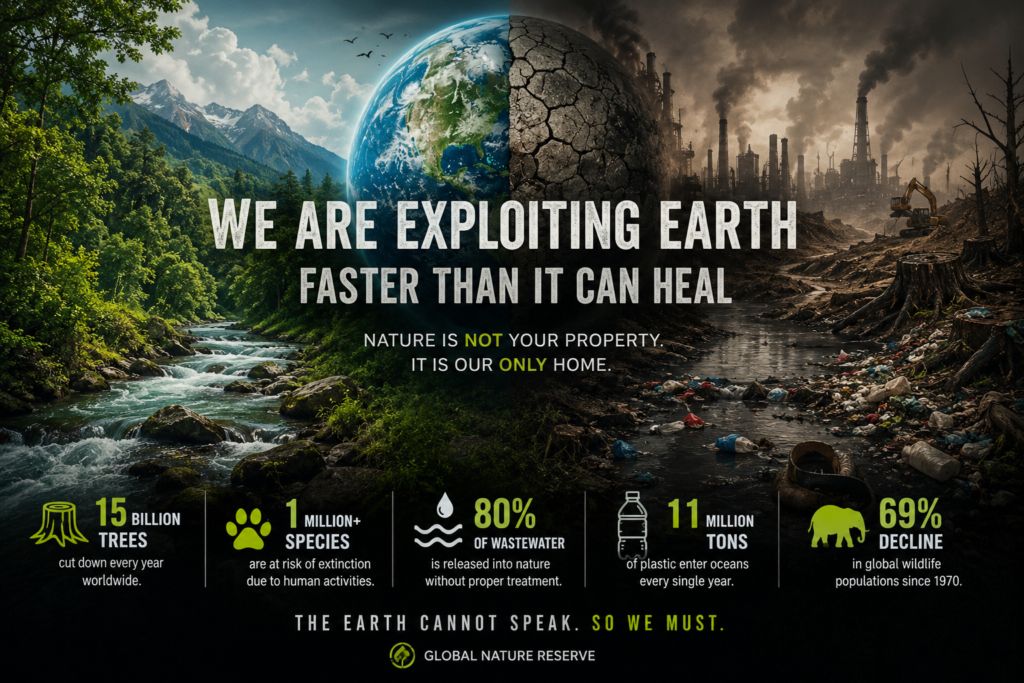
According to the Global Footprint Network, humanity uses ecological resources at a rate equivalent to nearly 1.7 Earths every year. In simple words, we are consuming nature 70% faster than the planet can naturally recover.
Every year:
- around 15 billion trees are cut down globally,
- more than 11 million tons of plastic enter oceans,
- and billions of tons of sewage and industrial waste pollute rivers and ecosystems.
What took nature thousands of years to create is being destroyed within decades.
Forests Are Disappearing
Forests are among the most important living systems on Earth.
They regulate climate.
Protect biodiversity.
Produce oxygen.
Store carbon.
Maintain rainfall cycles.
Yet humanity continues destroying them for:
- mining,
- urban expansion,
- agriculture,
- highways,
- and short-term economic growth.
According to the United Nations, the world has lost approximately 420 million hectares of forest since 1990 — an area larger than India.
Every forest destroyed is not just a loss of trees.
It is the collapse of an entire ecosystem.
Birds lose nesting grounds.
Animals lose shelter.
Rivers lose protection.
Soil loses stability.
Communities lose climate balance.
And once ancient forests disappear, they cannot simply be rebuilt.
Rivers Are Becoming Sewage Channels
Across many parts of the world, rivers are no longer treated as living ecosystems.
They are treated as waste disposal systems.
Industrial discharge, untreated sewage, plastic pollution, sand mining, and urban waste are destroying freshwater systems at an alarming rate.
The United Nations estimates that around 80% of global wastewater flows back into the environment without proper treatment.
This means rivers that once sustained civilizations are now carrying:
- chemicals,
- sewage,
- heavy metals,
- plastic waste,
- and toxic pollutants.
During field journeys across India, we witnessed rivers carrying more garbage than flowing water.
Children still play near polluted streams.
Animals still drink contaminated water.
Communities continue living beside ecosystems that are slowly collapsing.
This is no longer only an environmental issue.
It is a humanitarian crisis.
Wildlife Is Disappearing
Human activity is now pushing species toward extinction at terrifying speed.
According to the World Wildlife Fund’s Living Planet Report, monitored wildlife populations have declined by an average of 69% since 1970.
Habitats are disappearing because of:
- deforestation,
- wetland destruction,
- pollution,
- industrial expansion,
- and climate change.
Migratory birds lose resting wetlands.
Marine species consume plastic.
Large mammals lose forest corridors.
Entire ecosystems become fragmented.
And yet humanity continues expanding as if the Earth has infinite capacity. It does not.
Mountains Are Being Cut Open
Mountains are often seen as symbols of strength and permanence.
But even mountains are under attack.
Across many regions, quarrying, mining, deforestation, and uncontrolled tourism are damaging fragile mountain ecosystems that regulate water systems, biodiversity, and local climates.
Mountains are not simply rocks.
They are ecological guardians.
When mountains are destroyed:
- rivers are affected,
- landslides increase,
- biodiversity disappears,
- and climate systems become unstable.
The destruction of mountains is often ignored because it happens slowly.
But its impact lasts for generations.
Humanity Has Mistaken Exploitation for Progress
Modern civilization celebrates endless growth.
More extraction.
More construction.
More consumption.
More expansion.
But very little attention is given to ecological limits.
Humanity built economic systems that measure success through profit, while ecosystems are collapsing silently in the background.
We call it “development” when forests disappear for highways.
We call it “growth” when rivers are polluted by industries.
We call it “progress” when mountains are blasted apart.
But a civilization destroying the systems that sustain life is not progressing.
It is destabilizing its own future.
The Earth Is Warning Us
Climate disasters are increasing.
Heatwaves are intensifying.
Water scarcity is spreading.
Species are disappearing.
Air pollution is killing millions every year.
These are not isolated incidents.
They are symptoms of ecological imbalance.
Nature is responding to centuries of exploitation.
And despite technological advancement, humanity still depends entirely on:
- clean water,
- fertile soil,
- forests,
- biodiversity,
- and stable ecosystems.
Without nature, there is no economy.
No civilization.
No future.
Nature Is Not Property
The greatest mistake humanity made was believing Earth belongs to us.
A river is not property.
A forest is not empty land.
A mountain is not a mining block.
Wildlife is not an obstacle to development.
Nature is a living system.
And perhaps the future of civilization depends on whether humanity can relearn this truth before irreversible collapse begins.
This is why movements around the world are now demanding legal rights and sovereign entity status for rivers, forests, and ecosystems.
Because ecosystems cannot continue surviving under laws designed only for human profit.
Nature needs protection not as a resource —
but as life itself.
A Different Future Is Still Possible
Humanity still has a choice.
We can continue treating the Earth as something to exploit until ecosystems collapse beyond repair.
Or we can build a future based on:
- coexistence,
- ecological responsibility,
- restoration,
- and respect for life.
Protecting nature is no longer optional.
It is survival.
Final Words
The Earth has given humanity everything:
water, food, air, climate, biodiversity, life itself.
And yet modern civilization continues behaving as though nature is disposable.
But the truth is simple.
If rivers die,
humanity suffers.
If forests disappear,
civilization weakens.
If ecosystems collapse,
there is no technology powerful enough to replace them.
The Earth is not asking humanity for perfection.
Only responsibility.
And perhaps the most important question of our generation is this:
Will humanity continue exploiting the planet until nothing remains?
Or will we finally learn to live with nature instead of against it?
