
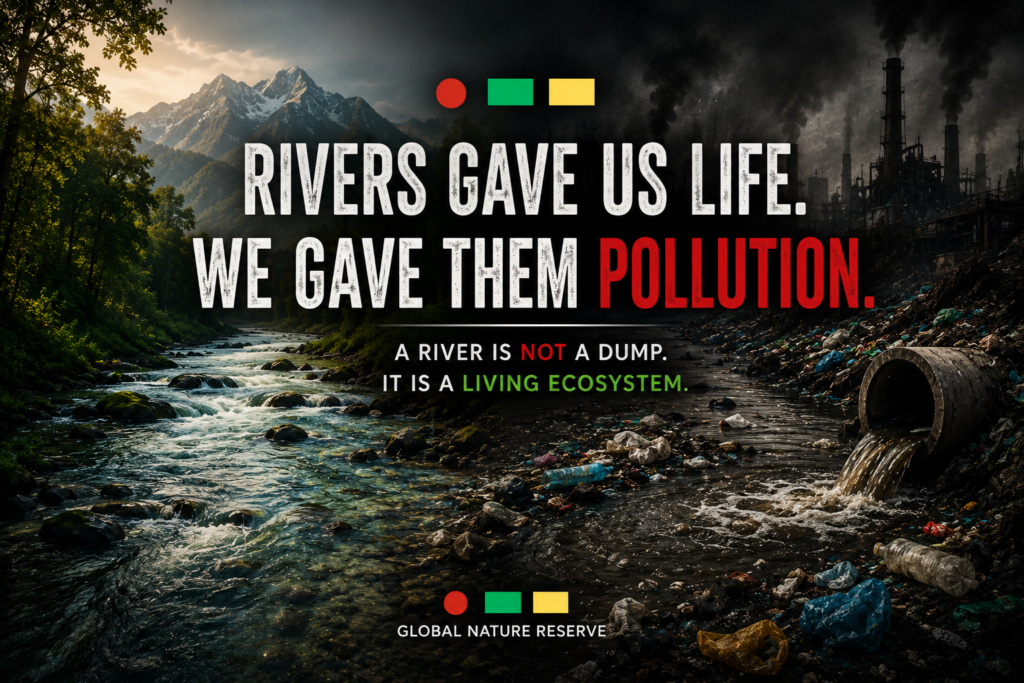
A river does not ask for much.
For thousands of years, rivers gave humanity everything:
- drinking water,
- fertile land,
- biodiversity,
- transportation,
- food,
- civilization itself.
The world’s oldest cities were built beside rivers.
Cultures worshipped them.
Communities survived because of them.
But modern civilization changed the relationship between humans and rivers.
We stopped seeing rivers as living ecosystems.
We began treating them like drains.
Today, many rivers across the world carry:
- sewage,
- plastic waste,
- industrial chemicals,
- toxic foam,
- medical waste,
- and untreated wastewater.
Humanity turned lifelines into waste channels.
And slowly, rivers are dying in silence.
Rivers Built Human Civilization
Almost every major civilization in history was born around rivers.
The Nile sustained Ancient Egypt.
The Indus supported one of the world’s oldest urban civilizations.
The Ganges became spiritually and culturally central to millions.
The Yangtze and Yellow Rivers shaped Chinese civilization.
Rivers were not simply water bodies.
They were living arteries of human survival.
Even today, billions of people depend directly on rivers for:
- drinking water,
- agriculture,
- livelihoods,
- and ecosystems.
Yet despite this dependence, rivers are among the most exploited systems on Earth.
Humanity Is Polluting Rivers Faster Than Nature Can Recover
According to the United Nations, around 80% of global wastewater is released into the environment without proper treatment.
Every day:
- industries dump chemicals into waterways,
- untreated sewage enters rivers,
- plastic waste accumulates along riverbanks,
- and urban expansion destroys natural river ecosystems.
Many rivers no longer flow naturally.
They struggle to survive beneath layers of pollution and ecological neglect.
In several parts of the world, rivers now carry:
- heavy metals,
- toxic industrial waste,
- pesticides,
- oil residues,
- and microplastics.
Some rivers even catch fire because of extreme chemical pollution.
This is not development.
It is ecological violence.
Rivers Are More Than Water
Most people look at rivers and see water.
But a river is far more than that.
A river is:
- biodiversity,
- groundwater recharge,
- climate regulation,
- agriculture,
- fisheries,
- wetlands,
- bird migration systems,
- and community survival.
When a river dies, an entire ecosystem begins collapsing with it.
Fish populations disappear.
Bird habitats vanish.
Groundwater weakens.
Farmers suffer.
Communities lose drinking water.
And eventually, human health collapses alongside ecological health.
A polluted river is never only an environmental problem.
It becomes a human crisis.
India’s Rivers Are Crying for Help
India is home to some of the most culturally significant rivers on Earth.
Rivers here are worshipped as mothers and sacred beings.
Yet many are heavily polluted.
According to India’s Central Pollution Control Board, hundreds of river stretches across the country are polluted due to untreated sewage, industrial discharge, and urban waste.
In many cities:
- sewage flows directly into rivers,
- plastic waste covers riverbanks,
- and industrial contamination affects surrounding ecosystems.
The contradiction is painful.
We pray to rivers.
Then we poison them.
We call them sacred.
Then we turn them into dumping grounds.
No civilization can survive long while destroying its own water systems.
Plastic Has Reached Even the Most Remote Rivers
Plastic pollution is no longer limited to oceans.
Rivers have become major carriers of plastic waste.
According to scientific studies, millions of tons of plastic enter oceans every year through rivers and waterways.
Plastic blocks water flow.
Damages aquatic ecosystems.
Kills wildlife.
Breaks down into microplastics.
And eventually enters human food and drinking water systems.
Humanity is now consuming the pollution it created.
The People Who Suffer Most
Environmental destruction rarely affects everyone equally.
The people who suffer first are often:
- poor communities,
- fishing families,
- farmers,
- Indigenous groups,
- and children living near polluted waterways.
Many communities continue depending on rivers even when the water becomes unsafe.
Animals still drink contaminated water.
Children still play near polluted streams.
People still wash, fish, and survive beside dying ecosystems because they have no alternative.
This is not only ecological injustice.
It is social injustice.
Rivers Cannot Defend Themselves
Perhaps the greatest tragedy is this:
A river cannot stand in court.
A river cannot protest.
A river cannot demand justice in human language.
And because rivers have no legal rights in most countries, they are treated as property instead of living systems.
This is why the Rights of Nature movement is growing globally.
Countries like Ecuador and New Zealand have already begun recognizing legal rights for ecosystems and rivers.
The idea is simple but revolutionary:
If corporations can have legal rights,
why not rivers?
If economic systems deserve protection,
why not ecosystems that sustain all life?
Rivers Need Rights, Not Sympathy
Humanity often responds to ecological destruction with temporary awareness campaigns.
But rivers do not only need sympathy.
They need protection.
Representation.
Legal recognition.
And long-term restoration.
A river should have:
- the right to flow,
- the right to remain pollution-free,
- the right to regenerate,
- and the right to exist without exploitation.
Because a river is not infrastructure.
It is life itself.
The Future Depends on Water
Climate change, population growth, pollution, and overconsumption are pushing global water systems toward crisis.
Future wars may not begin for land or oil.
They may begin for water.
And yet humanity continues polluting the very systems that sustain civilization.
This is not ignorance anymore.
The science is already clear.
We are simply choosing convenience over survival.
A Different Relationship With Rivers Is Still Possible
Rivers can recover when protected.
Pollution can be reduced.
Wetlands can be restored.
Plastic use can decline.
Communities can reconnect with ecosystems.
But this requires a shift in human thinking.
We must stop seeing rivers as resources to exploit.
And start seeing them as living systems to protect.
Because when rivers survive,
civilization survives with them.
Final Words
A river flowing freely is one of the purest forms of life on Earth.
It nourishes forests.
Feeds communities.
Supports wildlife.
Shapes landscapes.
Sustains civilizations.
And yet humanity has repaid that gift with pollution and exploitation.
Perhaps future generations will ask one painful question:
How did humans destroy the very rivers that gave them life?
The answer depends on what we choose to do now.
Because rivers are not property.
They are living ecosystems.
And they deserve the right to live.
