
By Global Nature Reserve
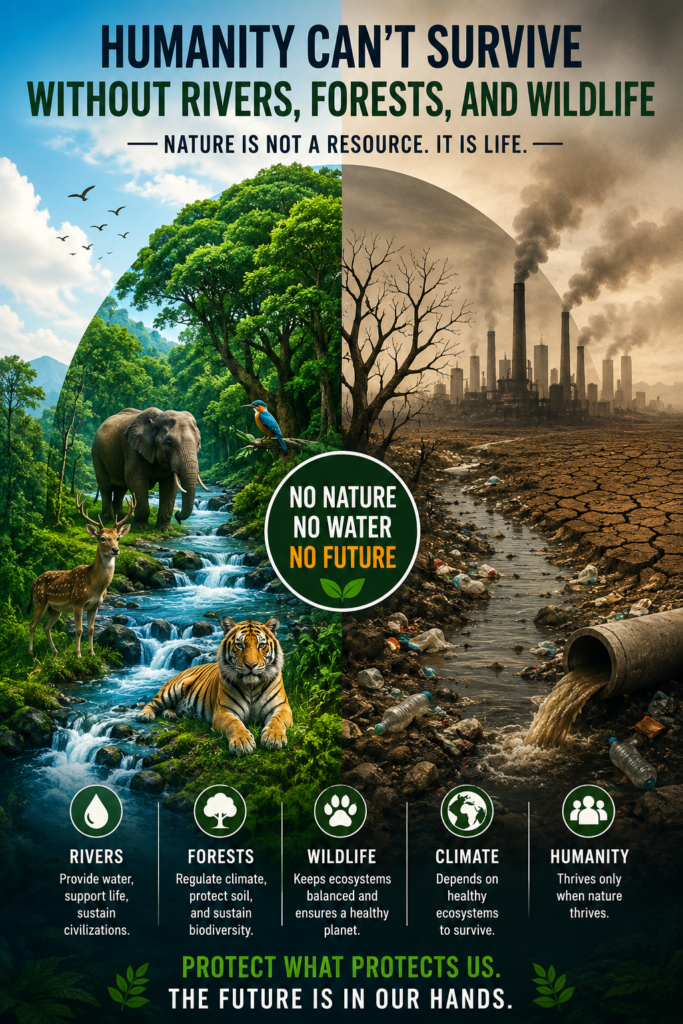
The Greatest Illusion of Modern Civilization
Modern civilization behaves as though humanity stands above nature.
Cities continue expanding.
Forests continue disappearing.
Rivers continue getting polluted.
Wildlife continues vanishing.
And yet humanity still believes economic growth alone can secure the future.
But there is one uncomfortable truth modern society avoids:
Humans cannot survive without functioning ecosystems.
No technology can replace:
- rivers,
- forests,
- biodiversity,
- fertile soil,
- clean air,
- or stable climate systems.
Nature is not separate from civilization.
Nature is civilization’s foundation.
Why Rivers Matter More Than Most People Realize
A river is not just flowing water.
A healthy river supports:
- agriculture,
- groundwater,
- biodiversity,
- forests,
- fisheries,
- drinking water,
- and local climate balance.
According to the United Nations, billions of people worldwide depend directly on freshwater ecosystems for survival. Yet rivers across the planet are under severe pressure from pollution, sewage discharge, industrial waste, and plastic contamination.
When a river dies:
- ecosystems collapse,
- farming weakens,
- drinking water becomes unsafe,
- and human health suffers.
Civilizations were built beside rivers for a reason.
Without rivers, human survival becomes unstable.
Forests Are Earth’s Natural Life Support System
Forests regulate rainfall, absorb carbon dioxide, protect biodiversity, cool temperatures, and maintain ecological balance.
Yet humanity continues cutting forests at massive scale for:
- mining,
- highways,
- urban expansion,
- agriculture,
- and industrial development.
The Food and Agriculture Organization estimates that the world has lost around 420 million hectares of forest since 1990.
That is not just deforestation.
It is the destruction of climate stability itself.
Without forests:
- temperatures rise,
- soil degrades,
- rainfall patterns change,
- and biodiversity disappears.
Humanity cannot destroy forests indefinitely and still expect climate stability.
Wildlife Is Not Optional for Ecosystems
Many people see wildlife as something distant from human life.
But ecosystems depend on biodiversity.
Birds spread seeds.
Insects pollinate crops.
Predators regulate populations.
Marine ecosystems support food systems.
According to WWF’s Living Planet Report, monitored wildlife populations have declined by an average of 69% since 1970.
This is not only a wildlife crisis.
It is a warning that ecosystems themselves are weakening.
When species disappear, ecosystems become unstable.
And eventually, humanity feels the consequences too.
Climate Change Is Not Separate From Ecological Destruction
Climate change is often discussed only as:
- carbon emissions,
- rising temperatures,
- or fossil fuels.
But climate collapse is deeply connected to ecosystem destruction.
Deforestation weakens carbon absorption.
Wetland destruction increases flooding.
River degradation worsens drought conditions.
Biodiversity loss destabilizes ecosystems.
Humanity cannot solve climate change while continuing to destroy nature.
The two crises are connected.
Modern Development Has Become Ecological Extraction
The problem is not development itself.
The problem is a system built on endless extraction.
Modern civilization often measures success through:
- consumption,
- expansion,
- construction,
- and profit.
But ecosystems are collapsing beneath that growth.
We call it “progress” when mountains are blasted apart.
We call it “development” when rivers are polluted.
We call it “urban growth” when forests disappear.
But no civilization can sustainably grow while destroying the systems that sustain life itself.
Nature Is Not Property
Perhaps the greatest mistake humanity made was believing Earth exists for ownership.
A forest is not empty land.
A river is not infrastructure.
A mountain is not merely a mining site.
Nature is a living system.
This is why environmental movements across the world are demanding legal rights and sovereign entity status for rivers, forests, and ecosystems.
Because ecosystems cannot survive under laws designed only around human profit and exploitation.
Nature needs protection as life —
not as property.
India Is Reaching an Ecological Crossroads
India is already experiencing:
- rising temperatures,
- water scarcity,
- polluted rivers,
- biodiversity loss,
- and worsening urban pollution.
Many cities struggle with:
- unsafe air,
- disappearing wetlands,
- plastic waste,
- and declining groundwater.
Yet ecological awareness still remains weak compared to the scale of the crisis.
The future of India depends not only on economic growth —
but on ecological survival.
Without healthy ecosystems:
- food systems weaken,
- water crises intensify,
- and public health deteriorates.
Environmental protection is no longer optional.
It is national survival.
Humanity Still Has Time to Change
The future is not completely lost.
Rivers can recover.
Forests can regenerate.
Wildlife populations can rebound.
Wetlands can be restored.
But this requires a shift in human consciousness.
Humanity must move from:
“How much can we extract from Earth?”
to:
“How do we coexist with it?”
The future depends on whether civilization learns this lesson before ecological collapse becomes irreversible.
Final Words
The Earth has never demanded perfection from humanity.
Only balance.
Only responsibility.
But modern civilization continues behaving as though nature is infinite.
It is not.
Without rivers,
there is no water security.
Without forests,
there is no climate stability.
Without biodiversity,
ecosystems weaken.
And without healthy ecosystems,
human civilization itself becomes fragile.
The question is no longer whether humanity is damaging the Earth.
The question is whether humanity will stop before the damage becomes irreversible.
Because nature is not separate from us.
Nature is what keeps us alive.
