
Yet I Walked the Entire Cauvery Delta. What I Saw Broke Me. An urgent ground report from Tiruchirappalli to Poompuhar.
By Global Nature Reserve
The Cauvery River is not just a river.It is one of the oldest living foundations of South Indian civilization.Empires rose beside it. Ancient traders sailed through its delta. Farmers survived because of it. Tamil culture flourished around it.For thousands of years,
the Cauvery nourished:
agriculture,biodiversity,temples,trade routes,wetlands,and human life itself.
But today, the river that built civilizations is slowly being suffocated by pollution, sewage, industrial waste, plastic dumping, sand mining, and ecological neglect.And most people only realize the damage when floods, droughts, or water shortages arrive.
I witnessed this reality while walking the Cauvery delta during my journey from Kanyakumari to Kashmir.
From Tiruchirappalli to the Cauvery Sangamam at Poompuhar, I walked through villages, riverbanks, agricultural lands, ancient cultural routes, and coastal communities connected to this river for generations.
What I saw was both beautiful and heartbreaking.
The Cauvery Delta Still Carries Ancient Tamil Civilization Walking through the delta feels like walking through living history.
You still witness:
ancient temples,farming communities,traditional fishing villages,cultural rituals,and traces of old trade routes that once connected Tamilakam to maritime civilizations.
Poompuhar itself was once one of the most important Chola port cities.
The Cauvery delta was not only fertile land.It was an economic and cultural engine of ancient South India.The river shaped identity itself.
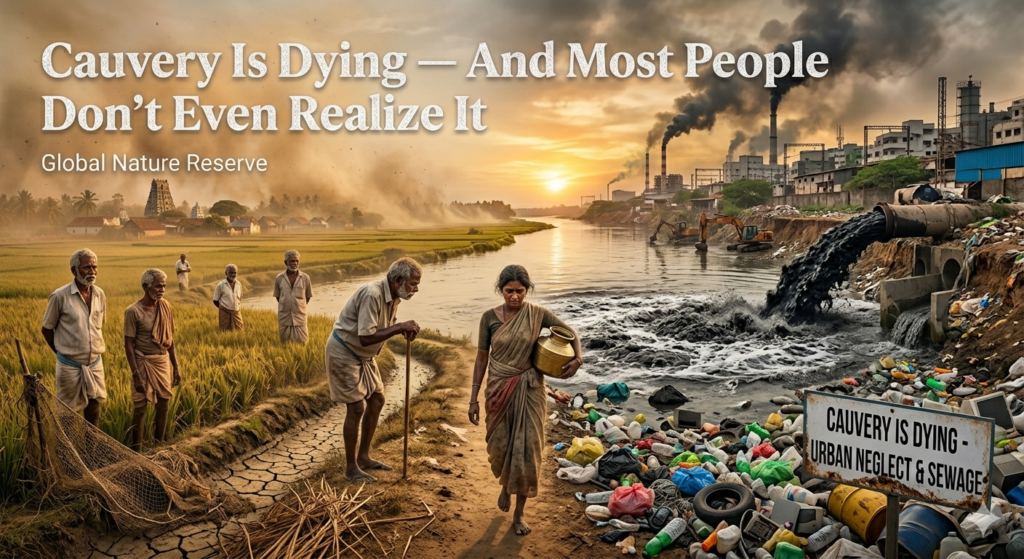
But now, many stretches of the same river are carrying:sewage,plastics,urban waste,industrial pollutants,and contaminated runoff.Civilization still depends on the Cauvery.
But modern civilization is no longer respecting it.
What I Saw During the Walk
As I walked through stretches of the Cauvery delta, the contradictions became impossible to ignore.
In one place: beautiful agricultural landscapes.In another: plastic waste trapped along riverbanks.
Near urban regions: sewage mixing into waterways.Near settlements: garbage dumped directly beside flowing water.
People still depend on the river daily: for farming,fishing,bathing,and livelihoods.Yet the ecosystem carrying all this life is under visible stress.
The saddest part is this:
Many people have become used to seeing polluted rivers.Ecological damage has become normalized.And normalization is dangerous.Because when destruction becomes ordinary, society stops reacting.
Current Cauvery Pollution Data Is Warning Us
Scientific and environmental studies continue showing serious ecological pressure across the Cauvery basin.
A 2025 water quality study using Tamil Nadu Pollution Control Board data found several Cauvery monitoring locations showing Biological Oxygen Demand (BOD) levels between 16–24 mg/L, far above the desirable limit of around 3 mg/L for healthy river systems. (ScienceDirect)
Higher BOD means:
organic pollution is consuming oxygen in the water — making survival harder for aquatic ecosystems.The same study also documented:high Total Dissolved Solids (TDS),increased conductivity,and signs of industrial and agricultural contamination in stretches around Tiruchirappalli. (ScienceDirect)
Another water quality assessment in the Tiruchirappalli region concluded that:sewage discharge,solid waste dumping,and human activities along riverbanks were significantly degrading Cauvery water quality. (Apricus Journals)
This is not emotional exaggeration.The data is already warning us.Sewage Is One of the Biggest Threats One of the most devastating realities across Indian rivers is untreated sewage.According to the United Nations, nearly 80% of wastewater globally returns to the environment without proper treatment. (Central Pollution Control Board)
Many Indian urban river systems continue receiving:
domestic sewage,greywater,and untreated drainage discharge.
Once sewage enters rivers:
oxygen levels decline,bacterial contamination rises,aquatic biodiversity weakens,and ecosystems begin collapsing slowly.
People often imagine river destruction as dramatic industrial disasters.But in reality, rivers often die slowly through everyday neglect.
Plastic Pollution Is Reaching Everywhere
Even remote river stretches are no longer untouched.
Plastic waste now appears:
along banks,near villages,around bridges,and inside waterways themselves.The Cauvery delta eventually meets the Bay of Bengal near Poompuhar.Which means every plastic item dumped upstream can eventually travel toward marine ecosystems.River pollution does not stay local.It spreads through entire ecological systems.
Sand Mining Is Quietly Destroying Rivers
Illegal and excessive sand mining is another major threat across Tamil Nadu.
Rivers naturally depend on balanced sediment systems.
When riverbeds are aggressively mined:
groundwater systems weaken,erosion increases,water flow changes,and ecological stability declines.Many people do not see this destruction directly because it happens gradually.But the long-term damage is severe.A river without ecological balance eventually becomes fragile.
Why the Cauvery Delta Matters to India
The Cauvery delta is often called the “Rice Bowl of Tamil Nadu.”
It supports:
agriculture,food systems,fisheries,wetlands,and biodiversity across massive regions.
If the Cauvery weakens, the consequences are not limited to one district.
Food security weakens. Groundwater suffers. Biodiversity declines. Livelihoods collapse.Protecting the Cauvery is not only environmental protection.It is protection of civilization itself.
The Most Dangerous Thing Is Human Silence
The river is warning us.Scientists are warning us.Farmers are warning us.Environmental reports are warning us.But public attention often remains temporary.
People react during:
floods,droughts,or water shortages.Then the urgency fades.
Meanwhile the river continues absorbing:
sewage,waste,and exploitation every single day.Rivers do not collapse overnight.They collapse slowly until recovery becomes extremely difficult.
Emergency: Tamil Nadu Must Act Now
The Cauvery does not need symbolic speeches.It needs urgent action.What Must Happen Immediately
1. Stop Direct Sewage DischargeEvery untreated sewage outlet entering the river must be identified and controlled urgently.
2. Strict Industrial MonitoringIndustries releasing pollutants into river systems must face stronger ecological accountability.
3. Riverbank Cleanup Campaigns Large scale community cleanup drives must become continuous movements not one-day events.
4. Protect Wetlands and FloodplainsWetlands connected to the Cauvery system must be restored and protected from encroachment.
5. Regulate Sand MiningIllegal and excessive extraction must be controlled before irreversible geomorphological damage occurs.
6. Public Ecological AwarenessPeople must stop seeing rivers as dumping spaces.No law alone can save rivers without public consciousness.
What Sovereign Entity Status Could Mean for Cauvery
Perhaps the most revolutionary shift would be recognizing the Cauvery as a living entity with legal rights.Not property. Not infrastructure. Not a resource to exploit endlessly.But a living ecosystem.
Under a Rights of Nature framework, the Cauvery could gain:
legal protection,ecological restoration rights,representation in environmental decisions,and stronger safeguards against pollution and exploitation.
This would change how governments, industries, and society interact with rivers.Because rivers are not economic objects.They are living systems sustaining life itself.
A Future Still Exists — But Not Forever
The Cauvery is still flowing.The delta is still alive.Birds still migrate. Farmers still cultivate. Communities still depend on the river every single day.But ecosystems have limits.And humanity is testing those limits dangerously.
The next decade may decide whether the Cauvery survives as a living river or slowly becomes another exhausted water system struggling under civilization’s weight.
Final Words
Walking through the Cauvery delta changed me.
Because I realized something painful:
Humanity always notices the value of rivers only after damaging them.
The Cauvery carried civilizations for thousands of years without asking anything in return.
Now it is asking for one thing:
Protection.
Not tomorrow. Not after another environmental conference. Not after another flood.
Now.
Because if the Cauvery collapses, Tamil Nadu loses far more than a river.
It loses part of its ecological soul.
