
Tamil Nadu’s Rivers Are Being Exploited — And the Cost Is Ecological Collapse
An in-depth report on river pollution, industrial exploitation, and the future of ecological justice in Tamil Nadu
By Global Nature Reserve
Tamil Nadu Was Built Around Rivers
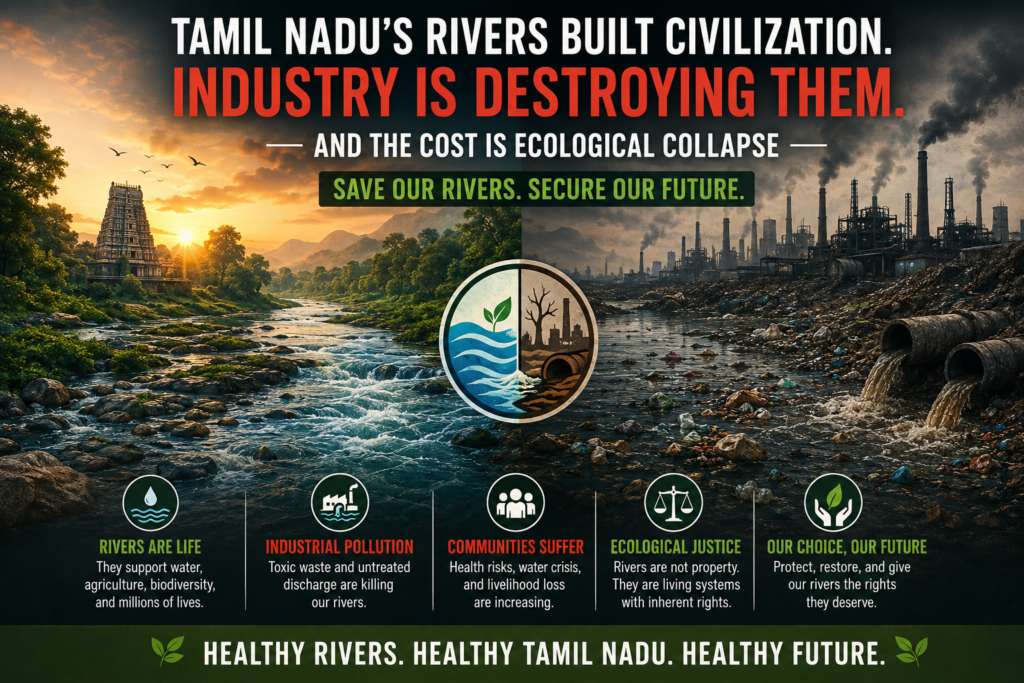
Long before highways, industries, and concrete cities, Tamil civilization grew beside rivers.
The Cauvery nourished agriculture and kingdoms.
The Vaigai shaped Madurai’s history.
The Tamirabarani sustained biodiversity and farming communities.
The Noyyal supported ecosystems across western Tamil Nadu.
The Palar once carried life across dry regions.
Tamil Nadu’s rivers were never just water bodies.
They were:
- culture,
- agriculture,
- trade,
- spirituality,
- biodiversity,
- and survival itself.
But today many of these rivers are struggling under:
- industrial discharge,
- sewage pollution,
- sand mining,
- encroachment,
- groundwater exploitation,
- and unchecked urbanization.
The rivers that once built civilization are now being sacrificed for short-term economic growth.
The Noyyal River: A Symbol of Industrial Exploitation
Few rivers represent ecological exploitation in Tamil Nadu more clearly than the Noyyal River.
Flowing through Coimbatore and Tiruppur regions, the Noyyal became heavily polluted due to decades of textile dyeing and bleaching industry discharge.
Research studies and environmental reports show that hundreds of textile dyeing units released wastewater containing:
- high Total Dissolved Solids (TDS),
- chlorides,
- dyes,
- and heavy metals into the river system.
A study linked to the Tamil Nadu Pollution Control Board documented that:
- around 729 dyeing units were operating in Tiruppur,
- generating nearly 96 million litres of wastewater per day,
- severely affecting the Noyyal River basin.
At Orathupalayam Dam downstream:
- toxic pollutants accumulated,
- groundwater became contaminated,
- and agricultural lands were damaged.
Water samples showed extremely high TDS and chloride levels far beyond ecological safety limits.
For years, local communities and farmers suffered ecological and economic losses because the river was treated as an industrial disposal channel.
The Hidden Cost of “Economic Growth”
Tiruppur became globally famous as a textile export hub.
But the river paid the price.
This is one of the deepest contradictions in modern development:
Economic success is celebrated.
Ecological destruction becomes invisible.
Factories generate employment and exports.
But rivers absorb the pollution.
Communities downstream inherit:
- contaminated water,
- damaged soil,
- ecological collapse,
- and long-term health risks.
The true environmental cost rarely appears in economic reports.
But rivers carry that cost silently.
The Vaigai River: From Civilization to Sewage Pressure
The Vaigai River once symbolized the heart of Madurai civilization.
Today, several stretches face:
- sewage discharge,
- plastic pollution,
- urban waste,
- and reduced natural flow.
Many citizens still emotionally connect with the river.
But emotional connection alone cannot restore ecosystems.
Without stronger river protection:
- biodiversity weakens,
- water quality declines,
- and urban river systems slowly collapse.
The tragedy is not only pollution.
It is normalization.
People begin accepting polluted rivers as ordinary.
That may be one of the most dangerous ecological shifts of all.
Chennai’s Waterways Are Under Severe Stress
Urban waterways connected to Chennai continue facing intense pollution pressure.
Recent reports highlighted untreated sewage continuing to enter canal systems despite regulatory interventions.
Rapid urbanization combined with:
- poor sewage infrastructure,
- plastic dumping,
- and encroachments
has weakened natural water systems across the region.
Flooding risks increase when wetlands and waterways lose ecological function.
Cities often forget:
waterways are not obstacles to urban growth.
They are protection systems.
Tamil Nadu’s Rivers Are Facing Multiple Threats Simultaneously
Most river crises in Tamil Nadu are not caused by one single factor.
The damage is cumulative.
1. Industrial Pollution
Industries linked to:
- textiles,
- leather,
- chemicals,
- dyeing,
- and manufacturing
continue placing pressure on river systems.
Even where treatment systems exist, ecological damage from decades of contamination remains difficult to reverse completely.
2. Sewage Discharge
Untreated or partially treated sewage remains one of the largest causes of river degradation.
As cities expand faster than infrastructure, waterways become waste channels.
3. Sand Mining
Illegal and excessive sand mining destabilizes riverbeds and affects groundwater systems.
It weakens the ecological structure rivers depend on.
4. Encroachment
Floodplains, wetlands, and river edges are increasingly occupied by:
- construction,
- urban expansion,
- and infrastructure projects.
Rivers lose space to breathe and flow naturally.
5. Climate Pressure
Erratic monsoons, droughts, and extreme rainfall linked to climate change are intensifying water stress across Tamil Nadu.
A damaged river system becomes even more vulnerable during climate extremes.
What the Data Is Showing
The Central Pollution Control Board (CPCB) continues identifying polluted river stretches across India based on Biochemical Oxygen Demand (BOD) and water quality monitoring.
Across India:
- 296 polluted river stretches were identified in recent assessments,
- with sewage and industrial discharge remaining major causes of degradation.
Tamil Nadu’s rivers are part of a much larger ecological warning.
The issue is no longer isolated pollution.
The issue is systemic ecological stress.
Why Current Environmental Protection Is Still Not Enough
Most environmental systems still operate under one dangerous assumption:
Nature exists for human use.
Under current frameworks:
- pollution is often “regulated,”
- extraction is “managed,”
- and ecosystems are valued mainly through economic usefulness.
But rivers are not machines.
They are living ecosystems.
Environmental law often tries to control damage after exploitation already begins.
By then, ecosystems are already weakened.
What Sovereign Entity Status Could Mean for Tamil Nadu
Imagine a different future.
Imagine if rivers in Tamil Nadu were legally recognized as living entities with rights.
Not as property.
Not as infrastructure.
Not as exploitable assets.
But as ecosystems deserving protection and dignity.
Under a sovereign entity or Rights of Nature framework, rivers could gain:
- legal representation,
- ecological protection rights,
- restoration rights,
- and stronger safeguards against destructive exploitation.
This would fundamentally change the relationship between industry, government, and ecosystems.
How Tamil Nadu Could Change
If rivers gained stronger ecological rights:
Industries would face stricter accountability
Polluting rivers would become a direct legal violation against a living ecosystem.
Communities would gain stronger protection
Farmers, fishing communities, and local residents could defend rivers more effectively.
Restoration would become mandatory
Damaged ecosystems would require long-term recovery instead of temporary cleanup projects.
Wetlands and floodplains would gain importance
Urban planning would need to respect ecological systems instead of erasing them.
Water security could improve
Healthy rivers strengthen groundwater recharge and ecosystem resilience.
Future generations would inherit living rivers instead of dead waterways
That may be the most important change of all.
Who Benefits If Rivers Are Protected?
Everyone.
Farmers benefit from healthier water systems.
Fisher communities benefit from restored biodiversity.
Cities benefit from stronger water security.
Wildlife benefits from healthier ecosystems.
Future generations benefit from ecological stability.
Even industries benefit long term —
because no economy can survive without functioning ecosystems.
Protecting rivers is not anti-development.
It is survival planning.
Tamil Nadu Needs Ecological Courage
Tamil Nadu has one of the strongest environmental awareness cultures in India.
But awareness alone is no longer enough.
The future requires:
- ecological responsibility,
- stronger river protection,
- restoration efforts,
- and a new relationship with nature itself.
Because rivers cannot continue surviving under systems built entirely around extraction.
Final Words
Tamil Nadu’s rivers are still flowing.
But many are flowing under pressure.
Pressure from pollution.
Pressure from extraction.
Pressure from urbanization.
Pressure from human greed.
And yet rivers continue sustaining life silently.
Perhaps the real question is not whether rivers can survive humanity.
Perhaps the question is whether humanity can survive after destroying its rivers.
Because when rivers collapse,
civilization eventually follows.
Nature is not property.
And one day, humanity may finally realize that rivers were never resources to own —
but living systems that kept us alive.
